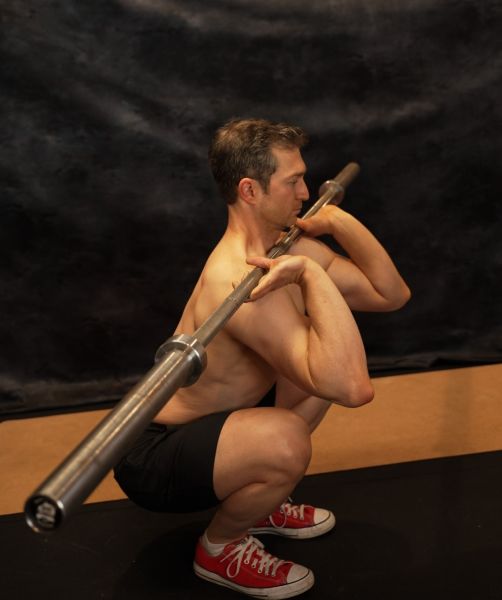
The Front Squat is a variation of the Back Squat that places more emphasis on the quadriceps by placing the barbell in front of the body instead of on your back. This also challenges the musculature o
Front Squat (Olympic)
Muscle Groups Involved
- Quads - Primary
- Erectors - Primary
Category
Barbell
Highlights
- Place your hands outside of your shoulders.
- Keep your elbows and chest high without hyperextending your back.
- Keep your entire spine neutral and do not look up as you squat.
- Drive your knees and heels outwards. Do not let your knees collapse inwards.
Description
The Front Squat is a variation of the Back Squat that places more emphasis on the quadriceps by placing the barbell in front of the body instead of on your back. This also challenges the musculature of your upper back and core. It is a mainstay in Olympic lifting and Crossfit gyms across the world. To perform the Front Squat, start in a standing position in front of a loaded bar. Brace your abdominals into a neutral spine position. Take a deep breath and redouble your brace as you step under the bar. Bring your hands either into a front rack position by placing your fingers under the bar and raising your elbows high towards the ceiling, or crossed across your body with each hand placed on the opposite shoulder. The barbell should rest on the front of your deltoids, and lightly across your collarbone for stability. Take two steps back into the squat position. Sit back into the squat as you lower yourself towards the floor while maintaining a relatively upright torso position throughout the movement. Brace hard at the bottom of the squat and press back up in a straight line to the starting position. Be sure to lock out your knees and hips at the same time.
Common Mistakes
Do not look up as you squat. Keep your entire spine in a neutral position t
Sign in to see all the informationDo not look up as you squat. Keep your entire spine in a neutral position throughout the entire movement. Do not lose your brace at any time during the lift, even while breathing. Do not dead lift the weight, but instead, “sit back” as if sitting in a chair.
Pro Tips
Pretend like you are ripping the carpet apart with your heels as you go up
Sign in to see all the informationPretend like you are ripping the carpet apart with your heels as you go up and down with the weight. This will put your knees into a safe and comfortable position for a better lift. Be sure to drop below 90 degrees of knee flexion to increase the activation of the vastus medialis obliquus (VMO), the teardrop shaped muscle closest to your knee. Brace extra hard at the bottom of the squat to prevent posterior pelvic tilt and back strain.
Purpose
This exercise places more emphasis on the quadriceps, specifically the VMO
Sign in to see all the informationThis exercise places more emphasis on the quadriceps, specifically the VMO or tear drop shaped muscle closest to your knee. It places less emphasis on the glutes which can be useful if you are trying to even up disproportionately large glutes as compared to your legs.
Form
Use a mirror to ensure that the bar is even throughout the movement. Video
Sign in to see all the informationUse a mirror to ensure that the bar is even throughout the movement. Video or a partner can check from the side to make sure you are not rounding your back or hyperextending throughout the movement.
Additional Names