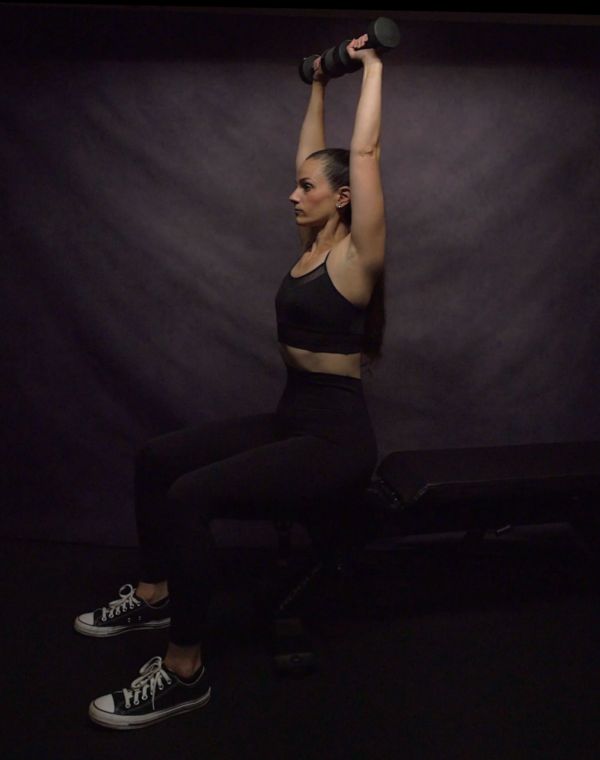
The Full Range of Motion Seated Dumbbell Shoulder Press focuses on the deltoid muscles and the upper back musculature, especially the upper trapezius. To perform the Full Range of Motion Seated Du
(FROM) Seated Dumbbell Shoulder Press
Muscle Groups Involved
- Delts - Primary
- - Primary
- Lats - Primary
Category
Dumbbell
Highlights
- Start with your hands in a comfortable position - not in front or to the sides, but in between.
- Keep your wrists and forearms underneath the dumbbell at all times.
- Do not arch your back. Do not move your head.
- Be sure to shrug at the top and go all the way down at the bottom.
Description
The Full Range of Motion Seated Dumbbell Shoulder Press focuses on the deltoid muscles and the upper back musculature, especially the upper trapezius. To perform the Full Range of Motion Seated Dumbbell Shoulder Press start in a seated position with dumbbells in each hand. Find a neutral position for your shoulder blades where they are not tucked back but not pulled forward. Maintain support underneath the weight at all times by keeping your forearms vertical below the dumbbells. Brace your core and press the weights up and over your head in a gentle arc. Pause briefly at the top while performing a mini shrug and then return the weights to the starting position under control.
Common Mistakes
Flaring your elbows out too much puts excessive strain on the shoulder with
Sign in to see all the informationFlaring your elbows out too much puts excessive strain on the shoulder without added benefit. Tucking your elbows in too much puts too much bias on the anterior deltoid alone, making the exercise less effective. You do not need to touch the dumbbells at the top but you should attempt to if it is comfortable and do not press straight up only.
Pro Tips
Imagine pushing your armpits forwards and out as you press the weight up to
Sign in to see all the informationImagine pushing your armpits forwards and out as you press the weight up to create more external rotation which will stabilize your shoulder. Pulling the weight back down to its starting position will also improve control and make your stabilizer muscles work harder.
Purpose
This exercise will help fill in any missing gaps in your development and pr
Sign in to see all the informationThis exercise will help fill in any missing gaps in your development and produce well rounded shoulder development if performed correctly. It also helps develop the tie in between your neck and shoulders and shoulders and chest for a more aesthetic appearance as well as improved control while working overhead.
Form
You should keep your hands in scaption which means in line with your should
Sign in to see all the informationYou should keep your hands in scaption which means in line with your shoulder blades; not too far forwards, not out to your sides. At the top be sure to shrug your shoulders up as if you were reaching high above you to complete the full range of motion for this exercise.
Additional Names