
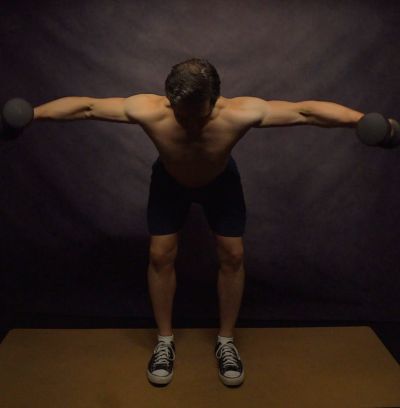
The Rear Delt Raise targets the posterior deltoid and middle trapezius muscles. It is a great exercise for shoulder health and stability as well as balancing out one’s upper body proportions. To
Rear Delt Raise
Muscle Groups Involved
- Delts - Rear - Primary
- Mid Back/Mid Traps - Primary
Category
Dumbbell
Highlights
- Bend over at the hips to 30-45 degrees.
- Slightly bend your elbows and keep them locked in for the entire movement.
- Move your arms as if you're hugging a large tree, keeping elbow pits facing each other.
- Do not bring elbows down towards hips, keep your elbows up high towards your ears.
- Make sure to move your shoulder blades forwards and backwards as you move your arms.
Description
The Rear Delt Raise targets the posterior deltoid and middle trapezius muscles. It is a great exercise for shoulder health and stability as well as balancing out one’s upper body proportions. To perform this exercise start in a standing position with your torso between 30 and 45 degrees to the floor. Start the movement by squeezing your shoulder blades together as you raise your arms up towards the ceiling. Bring your hands up until they are even with your torso. Pause briefly at the top before lowering the dumbbells under control.
Common Mistakes
The most common mistake is externally rotating your shoulders while perform
Sign in to see all the informationThe most common mistake is externally rotating your shoulders while performing the exercise. To prevent this keep your “elbow pits” facing each other throughout the entire movement. Another way of thinking about this is to keep your elbows pointed towards the ceiling and not towards your hips. Be sure to include shoulder blade movement to get the most out of the exercise.
Pro Tips
Stop your reps before gravity takes over to produce more tension on the mus
Sign in to see all the informationStop your reps before gravity takes over to produce more tension on the muscle for better activation. This is also a great core exercise if you brace your abs and put tension on your hamstrings, glutes and low back. Keep a neutral spine position and “sit back” into your position to improve stability.
Purpose
Rear deltoids are often ignored by the average gym goer and so developing t
Sign in to see all the informationRear deltoids are often ignored by the average gym goer and so developing these muscles will balance out your physique while helping you stand out in a crowd. Well balanced shoulders can also improve posture.
Form
Be sure that your palms face each other and your elbow pits face each other
Sign in to see all the informationBe sure that your palms face each other and your elbow pits face each other throughout the movement like a bear hug. Do not tilt your hands upwards or your elbows downwards. Keep strict form and make sure your shoulder blades move during the movement.
Additional Names