
The Rotary Deadlift is a unique exercise developed by Dr. George Morris that focuses on building strength in your most vulnerable positions. It strengthens the muscles and connective tissues in your l
Rotary Deadlift
Muscle Groups Involved
- Erectors - Primary
- Glutes - Primary
- Hamstrings - Primary
Category
Dumbbell
Highlights
- A neutral or slightly rounded spine is the goal.
- Do not push through pain.
- Do not swing the weight or use inertia.
- Use light weights with perfect form before progressing.
Description
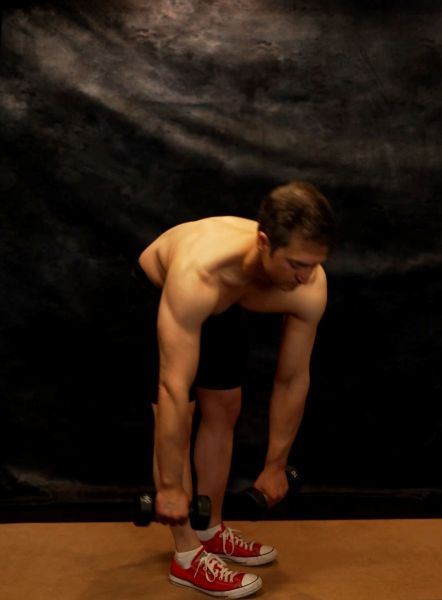
The Rotary Deadlift is a unique exercise developed by Dr. George Morris that focuses on building strength in your most vulnerable positions. It strengthens the muscles and connective tissues in your low back, hips and legs to prevent injury and increase your functional range of motion. To perform the Rotary Deadlift start in a standing position holding a dumbbell in each hand, palms facing your body. Start by bracing your abdominals and glutes while flexing at the hips. Lean to your right side and flex forwards towards 2 o’clock if 12 is straight in front of you. Stop at your typical range of motion of a straight leg deadlift and maintain that height as you swing the weights across your body, rotating your torso at the same time. Stop when your shoulders are facing about 10 o’clock. From this position return back to the upright starting position. Repeat this circular motion for the desired number of repetitions. Then rest and repeat again going in the opposite direction.
Common Mistakes
Do not excessively round or arch your back. Aim for a neutral spine or slig
Sign in to see all the informationDo not excessively round or arch your back. Aim for a neutral spine or slightly flexed position that you maintain throughout the entire movement. Do not actually swing the weight or use inertia. Instead, use controlled movements. Do not only do one direction. Be sure to keep the weights and reps easy enough that you can complete the same number of repetitions for both directions.
Pro Tips
Consider starting on a different side each time you perform the exercise to
Sign in to see all the informationConsider starting on a different side each time you perform the exercise to keep the training stimulus evenly distributed across both sides.
Purpose
This exercise builds the posterior chain with a particular focus on the lum
Sign in to see all the informationThis exercise builds the posterior chain with a particular focus on the lumbar paraspinals, quadratus lumborum, gluteus medius, and hamstrings muscles.
Form
Be sure that you are not excessively rounding your arching your back. Your
Sign in to see all the informationBe sure that you are not excessively rounding your arching your back. Your toes should not come up during any part of the exercise.
Additional Names