
The Single Leg Deadlift targets the muscles in your posterior chain from the base of your skull to your heels. It emphasizes your hamstrings and glutes while also challenging your balance and coordina
Single Leg Deadlift
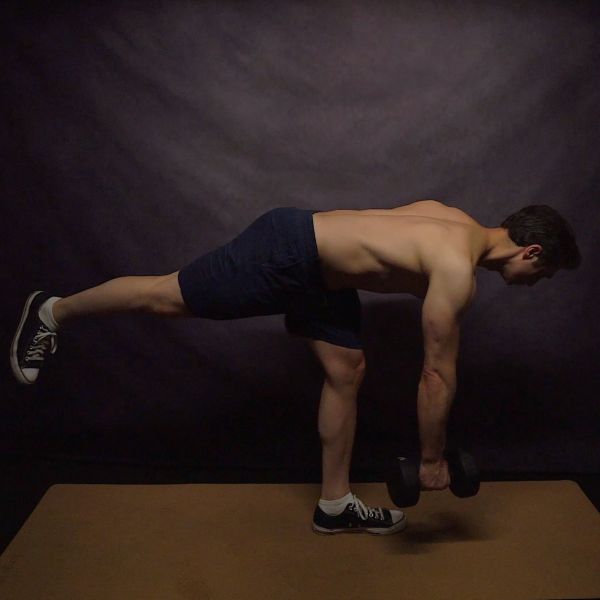
Muscle Groups Involved
- Hamstrings - Primary
- Glutes - Primary
- Erectors - Primary
- Abs/Core - Primary
Category
BodyweightDumbbell
Highlights
- Your leg and torso are one unit. They move together the entire time. Keep your leg in line with your torso.
- Brace you core to improve balance.
- Hold the weight in the hand opposite the standing leg.
- Do not look up. Keep your spine neutral the entire time.
- Think about kicking the moving leg forwards to get back to the starting position.
Description
The Single Leg Deadlift targets the muscles in your posterior chain from the base of your skull to your heels. It emphasizes your hamstrings and glutes while also challenging your balance and coordination. Start in a standing position with a weight in the hand opposite of your working leg. Brace your core and bend at the hip while keeping your non-standing leg in line with your torso. While maintaining a neutral spine, lower the weight until you feel a good stretch in your hamstrings. Pause briefly and return to the starting position under control.
Common Mistakes
The non-standing leg must be in line with your torso and not trailing behin
Sign in to see all the informationThe non-standing leg must be in line with your torso and not trailing behind or ahead of the movement with your body. A braced core throughout the movement is necessary to maintain a neutral spine position. Do not sacrifice a neutral spine for a deeper stretch.
Pro Tips
Imagine a string pulling your non-standing leg big toe back to the starting
Sign in to see all the informationImagine a string pulling your non-standing leg big toe back to the starting position. Create a tripod with your standing foot by pushing the ball of your foot, the base of your pinky toe and your heel firmly into the ground to improve balance and coordination.
Purpose
Hamstrings respond to and develop well in the lengthened position. This exe
Sign in to see all the informationHamstrings respond to and develop well in the lengthened position. This exercise will improve the tie in between the hamstrings and the glutes and improve muscular development in an area where most people are lacking.
Form
Your leg should be in a straight line with your torso at all times. Your ne
Sign in to see all the informationYour leg should be in a straight line with your torso at all times. Your neck should be in a neutral position with the rest of your spine. Your hips should be facing the floor and not turned out to the side.
Additional Names