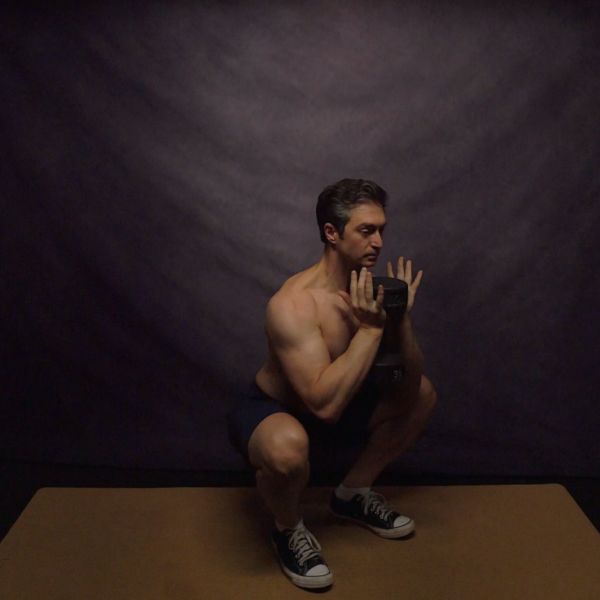
The Goblet squat targets the quadriceps muscles in the front of your thighs while also challenging your upper back, core and shoulders. These can be particularly useful for cardiovascular training as
Goblet Squat
Muscle Groups Involved
- Quads - Primary
- Glutes - Primary
- Hamstrings - Primary
- Erectors - Primary
Category
DumbbellKettlebell
Highlights
- Brace your abs before sitting back into the squat.
- Keep your elbows in tight under the weight.
- Think about tearing the carpet apart with your heels as you lower and raise yourself back up to increase glute activation.
- Getting your knees out to the sides will make room for your torso to descend.
Description
The Goblet squat targets the quadriceps muscles in the front of your thighs while also challenging your upper back, core and shoulders. These can be particularly useful for cardiovascular training as they put a lot of strain on breathing. To perform this exercise start with a dumbbell positioned vertically. Use the heels of your palms to support the bell end of the weight. While keeping your shoulders braced backwards, tuck your elbows forwards underneath your hands to support the weight. Brace your core and sit back to start the squat. Maintain core stiffness throughout the movement and pause at the bottom. Drive your heels into the floor and return to the starting position.
Common Mistakes
Maintain a braced core throughout the movement and do not hyperextend your
Sign in to see all the informationMaintain a braced core throughout the movement and do not hyperextend your lower back as you sit back into the squat. Keep your elbows tucked in and do not allow them to flare out. Stand tall and push through your head to keep your chin from jutting out which will place excess stress on your neck.
Pro Tips
Pushing your knees out or attempting to tear the carpet apart using your he
Sign in to see all the informationPushing your knees out or attempting to tear the carpet apart using your heels will help with leg drive which will give you a better contraction in your quadriceps, making the exercise more effective.
Purpose
Goblet squats place more emphasis on the quadriceps, and if performed deepl
Sign in to see all the informationGoblet squats place more emphasis on the quadriceps, and if performed deeply, the vastus medialis or the teardrop-shaped muscle above your knee specifically. Developing this muscle will balance out the shape of your quads filling out the difficult to build lower portion.
Form
You should sit back into the squat with a more upright torso as compared to
Sign in to see all the informationYou should sit back into the squat with a more upright torso as compared to a back squat. Your knees should track outwards. Keep your elbows tucked underneath your hands as best as you can to support the weight and protect your wrists.
Additional Names