
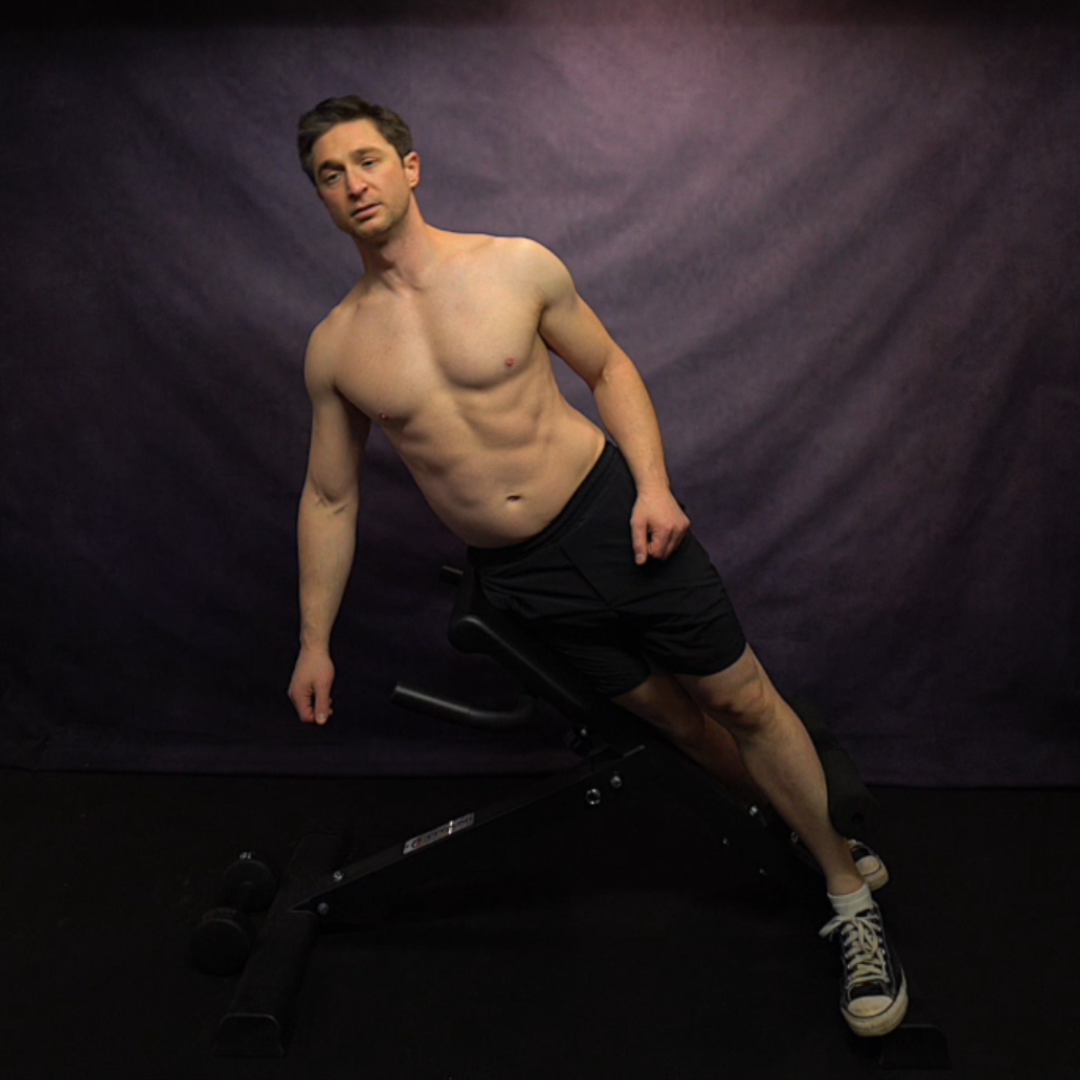
The QL Raise is a popular variation on the hyperextension exercise that strengthens the obliques and the quadratus lumborum (QL), an important stabilizer in your lower back. To perform the QL Rais
QL Raise
Muscle Groups Involved
- Obliques - Primary
- QL (quadratus lumborum) - Primary
- Glutes - Primary
- Abs/Core - Primary
Category
Highlights
- Brace your core throughout the entire exercise.
- Think
- Do not lean forward or twist.
- Hold a weight or raise your arms up to add resistance if the exercise is too easy.
Description
The QL Raise is a popular variation on the hyperextension exercise that strengthens the obliques and the quadratus lumborum (QL), an important stabilizer in your lower back. To perform the QL Raise start in a roman chair in a sidelying position with your top foot in the front position. You can hold a dumbbell in your hand or choose to let your arm hang freely. Brace your core as you lower yourself sideways towards the floor. Keep your chest and torso square to the wall that you are facing. Do not twist. Pause briefly in the stretched position before contracting your core to bring you back up to the starting position.
Common Mistakes
Do not let yourself fall. Use control to lower yourself. Do not use inertia
Sign in to see all the informationDo not let yourself fall. Use control to lower yourself. Do not use inertia on the way back up. Do not let your brace go while performing the exercise. Do not use a weight too heavy to perform the full range of motion. Do not “bounce” at the bottom”.
Pro Tips
You can use your arms for graded, scalable resistance by raising them up to
Sign in to see all the informationYou can use your arms for graded, scalable resistance by raising them up to your chest, to your head, or even above your head in increasing levels of difficulty.
Purpose
The QL raise is a popular exercise for spinal rehab, core stability and ath
Sign in to see all the informationThe QL raise is a popular exercise for spinal rehab, core stability and athleticism. It strengthens the muscles in the coronal plane which helps with lateral (side-to-side) movement.
Form
Your torso should be in a straight line with your legs at the top of the ex
Sign in to see all the informationYour torso should be in a straight line with your legs at the top of the exercise. Do not lean forward or arch back as you lower yourself to keep in a straight line the whole time.
Additional Names
Hyperextension Side Bend (weighted and unweighted), Lateral hyperextension