
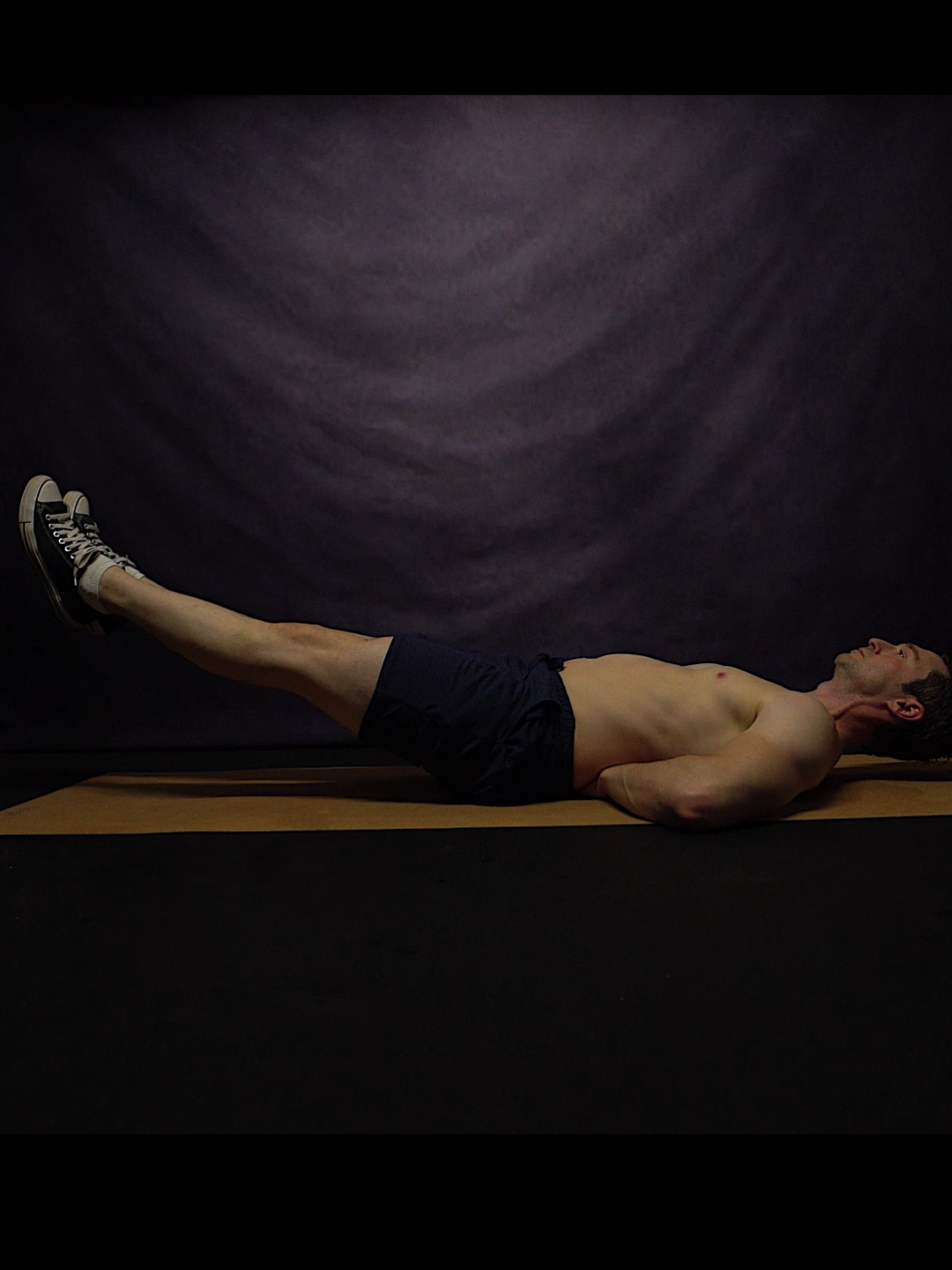
The Leg lift is a straightforward core-strengthening exercise. Leg lifts target the lower abdominal muscles and hip flexors, promoting core strength and stability. To perform Leg Lifts, start in a
Leg Lift
Muscle Groups Involved
- Hip Flexor - Primary
- Quads - Primary
- Abs/Core - Primary
Category
Bodyweight
Highlights
- Brace your abs and flatten your back to the floor before lifting your leg.
- Do not let your abs dome. Keep them flat.
- Lower under control.
- Do not arch your back.
Description
The Leg lift is a straightforward core-strengthening exercise. Leg lifts target the lower abdominal muscles and hip flexors, promoting core strength and stability. To perform Leg Lifts, start in a lying position on your back with your arms by your sides. Alternately, you can place your hands under the small of your back to maintain a neutral spine position. Keep your legs together and straight. Start the movement by bracing your abdominals and flattening your back against the ground or the backs of your hands. Lift both legs off the ground simultaneously, using your abdominal muscles to raise them until they are approximately a foot off the floor. Hold briefly at the top, then lower your legs back down with control, avoiding arching your back. Pause briefly without touching or resting on the floor and repeat the movement.
Common Mistakes
Do not place your hands under your buttocks for support as this wedges your
Sign in to see all the informationDo not place your hands under your buttocks for support as this wedges your pelvis in place and may cause unnecessary strain to your back while limiting the effectiveness of the exercise.
Pro Tips
If you feel or hear a click in your hip, stretch your hip flexors. The purp
Sign in to see all the informationIf you feel or hear a click in your hip, stretch your hip flexors. The purpose of this exercise is to use your legs to add resistance to your abdominals so that your pelvis does not anteriorly rotate. Put more simply, this is an isometric exercise where you do not want to crunch your abdominals. Keep your abs braced and control your breathing to maintain that brace during the entire exercise.
Purpose
Leg Lifts are great for targeting the lower abdominals and the hip flexors.
Sign in to see all the informationLeg Lifts are great for targeting the lower abdominals and the hip flexors. This variation keeps the tension high at the most challenging portion of the movement. This is also a great "anti-extension" exercise which teaches you to brace your core in a neutral position instead of hyperextending.
Form
Your back should be pressed firmly into the ground or against your hands to
Sign in to see all the informationYour back should be pressed firmly into the ground or against your hands to maintain a neutral spine position. Arching your back can cause pain and decrease the effectiveness of the exercise.
Additional Names
Leg Raise, Lying Leg Raise